Freelance Designer Home Office 2026: Simplified Method vs Form 8829 — Schedule C Line 30
This is education, not tax advice. I'm not a CPA or EA. State taxes are not covered.
Schedule C cited below is IRS draft as of 2026-10-07 — DRAFT, NOT FOR FILING. If a line changes, this page is updated in place with a dated note at the foot of the article.
- Last checked
- Tax year
- 2026
- Core line
- Schedule C, line 30 — expenses for business use of your home
- Changes
- Update log (1)
§1One job, one tax year, one line
One job, one tax year, one line. The job is freelance designer and consultant — solo, billing clients directly, filing Schedule C. The year is 2026. The line is Schedule C, line 30: expenses for business use of your home.
Line 30 is where this site's Fork pillar lives in its purest form. Two printed routes lead into the same line — one is a single multiplication worked out in the instructions, the other is an entire second form — and this article reads both doors without walking through either one for you.
§2Where line 30 sits
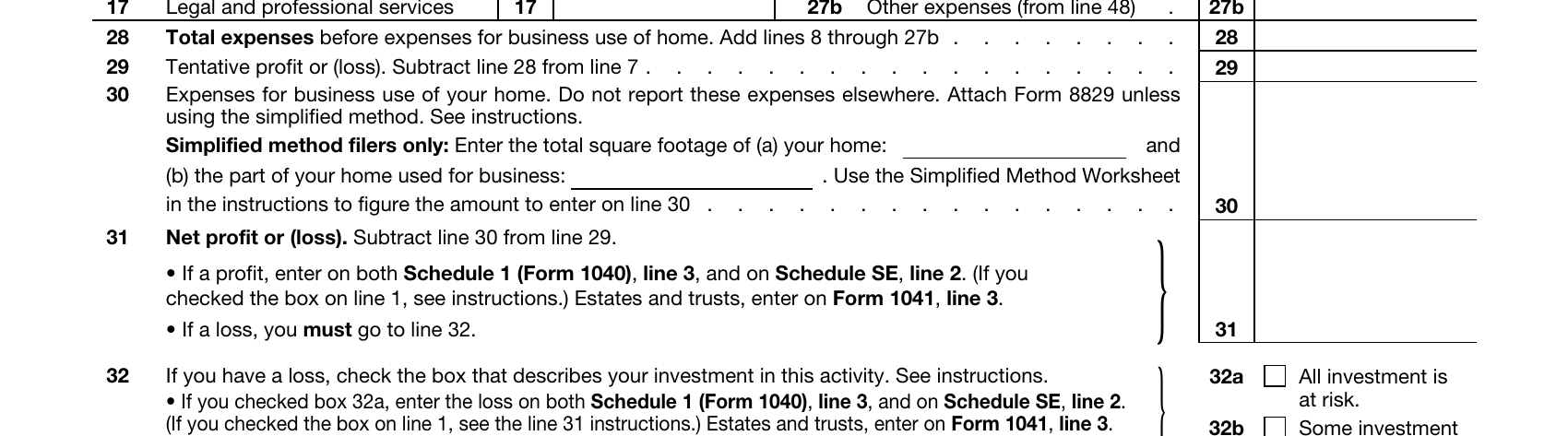
Read line 30 in its neighborhood, because Schedule C saves this expense for nearly last.
Part II of Schedule C totals the year's expenses at line 28 — and line 28 is the total taken before expenses for business use of your home. Line 29 is tentative profit or loss: gross income minus that line 28 total. The home expense has not been touched yet.
Then line 30: expenses for business use of your home. Its printed text names its own two sources — attach Form 8829, unless the simplified method is being used, in which case the worksheet is in the Schedule C instructions.
Line 31 subtracts line 30 from line 29 and produces net profit or loss, and line 31's destinations are printed on the form: Schedule 1, line 3, and Schedule SE, line 2. So whatever amount lands on line 30 does not sit off to the side — it moves the net profit figure that both the income tax side and the self-employment tax side of the return read next.
§3The tests standing in front of the line
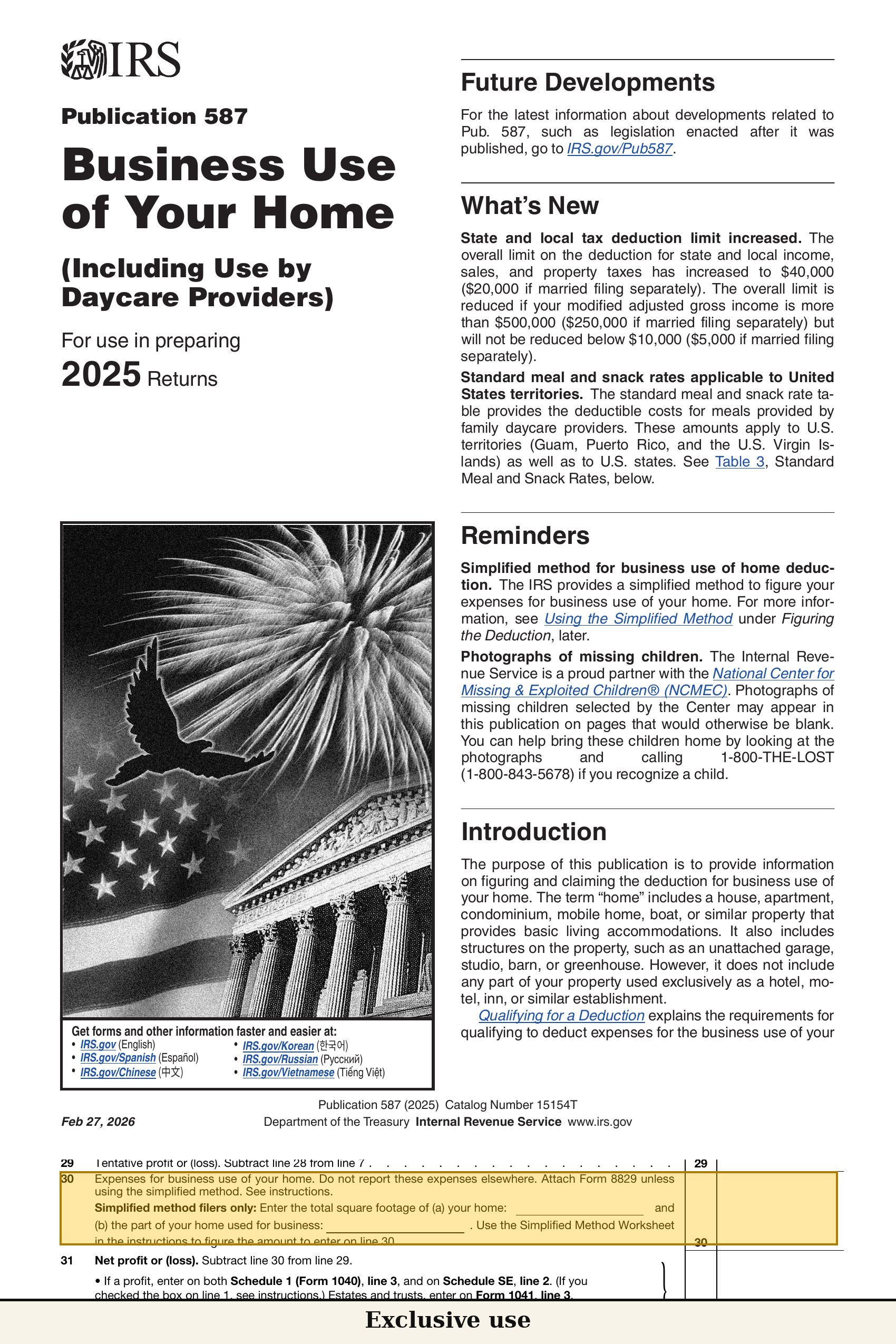
Publication 587 cover/title card beside the Schedule C line 30 zoom. Callouts: "Exclusive use" / "Regular use" / "Principal place of business". No rule text beyond the test names.
Before either route produces a number, there are gates, and they are not on Schedule C. Publication 587 is where the IRS keeps them: tests with names — exclusive use, regular use, and the principal place of business test. Schedule C line 30 assumes those questions; it does not ask them. This article names the tests and where they live, and reads the two cases this site keeps for what the principal-place test is — because that test was built in a courtroom.
In Soliman, decided by the Supreme Court in 1993, the principal place of business was decided by comparison: weigh the relative importance of the activities at each place, and the time spent at each place. That is the comparative test the Supreme Court used in Soliman. One flag travels with it, stated here because it changes what the case can mean: Soliman is pre-1999 law, and a 1997 Act rule for administrative and management activities — effective 1999 — can produce a different result for a solo filer today.
The same comparison cut the other way in Popov, in the Ninth Circuit in 2001: a violinist who practiced four to five hours a day in a living room used for nothing else. Its flags travel with it too: the taxpayer was a W-2 employee, the law was pre-1999, and it binds one circuit. It is used here for the shape of the analysis, and for nothing else.
Exclusive use has its own decided example, under current law. In a 2011 Tax Court case, a self-employed accountant's bedroom office counted at 8.45% of his home, but the hallway and bathroom next to it counted for nothing because his children and guests occasionally used the bathroom.
§4Door one: the simplified method, and the worked example
Door one: the simplified method, printed in Revenue Procedure 2013-13 and carried in the IRS's own summaries.
The build is one multiplication. Five dollars per square foot of the part of the home used for business. Two printed limits ride on it: the area counted stops at 300 square feet, and the amount stops at $1,500. The worksheet that walks it sits in the Schedule C instructions — line 30's own text points there. And notice what is not attached on this route: no Form 8829. The instructions' worksheet stands in its place.
One worked example, with numbers used only in this article. A freelance designer — hypothetical, not a prediction, not your numbers — works from a dedicated room of 240 square feet, used exclusively and regularly for the design business.
240 square feet times $5 is $1,200. Check it against both printed limits: 240 is under the 300-square-foot limit, and $1,200 is under the $1,500 cap, so neither limit trims it. Line 30 takes $1,200.
Now read the cap doing its work, once, at the limit itself. At 300 square feet the multiplication reaches $1,500 — exactly the printed maximum — and any area beyond 300 adds nothing on this route, because the square-foot limit and the dollar cap meet at that point. That is the whole arithmetic of door one: one multiplication, two limits, and an answer that never asks what the home actually cost to run.
| Step | Source line | Operation | Amount |
|---|---|---|---|
| Dedicated home office area, used exclusively and regularly for the design business | Hypothetical input | Invented for this article | 240 sq ft |
| Simplified-method rate | Rev. Proc. 2013-13 | Printed rate per square foot | $5 |
| Multiplication | Simplified method | 240 × $5 | $1,200 |
| Square-foot limit check | Printed limit | 240 sq ft is under the 300 sq ft limit — no trim | — |
| Dollar cap check | Printed limit | $1,200 is under the $1,500 maximum — no trim | — |
| Amount entered on Schedule C | Line 30 | Simplified method result | $1,200 |
| Printed-limit read (not a second example) | Rev. Proc. 2013-13 | At 300 sq ft: 300 × $5 = $1,500 — the square-foot limit and the dollar cap meet; area beyond 300 adds nothing on this route | $1,500 |
§5Door two: Form 8829
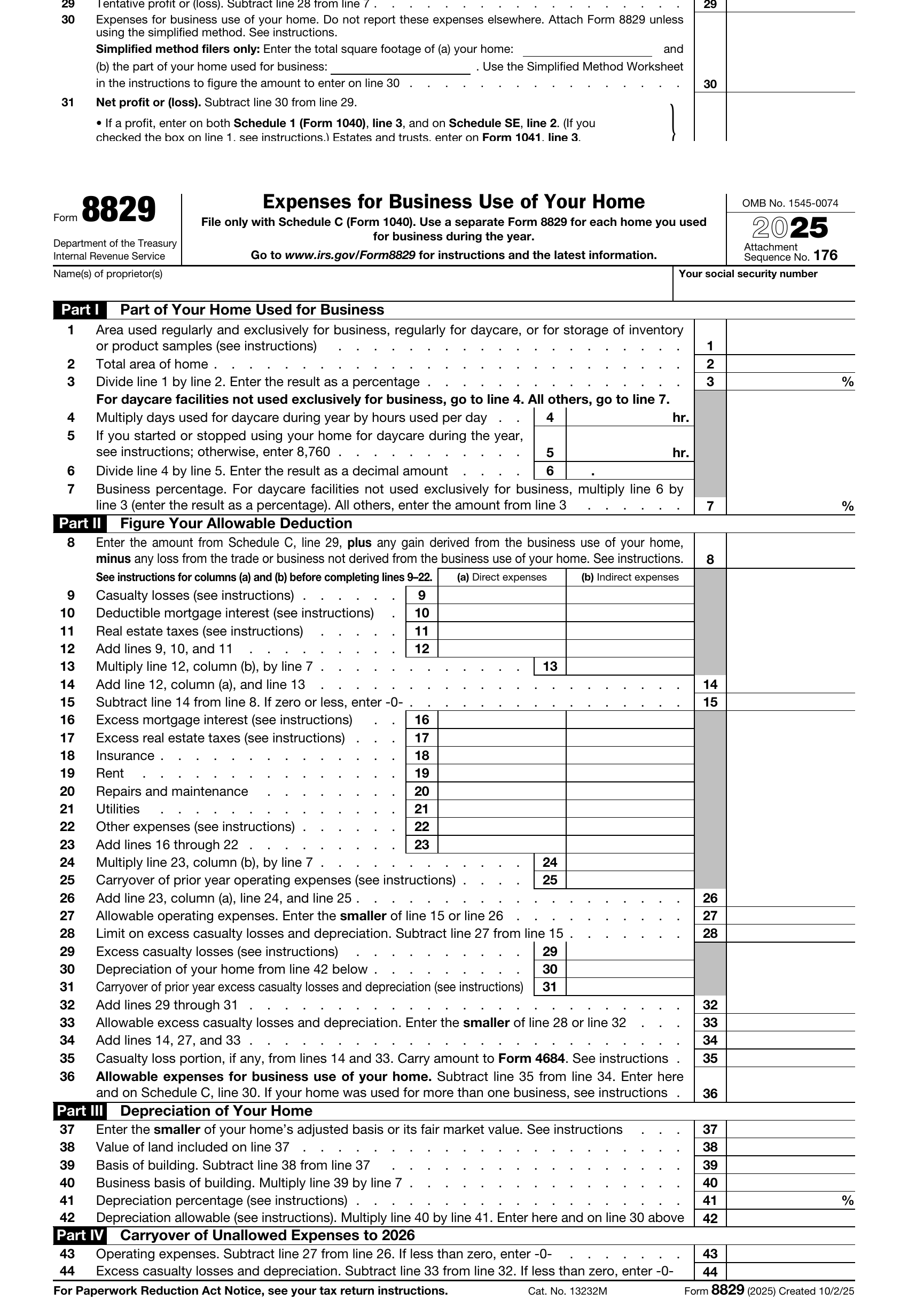
Schedule C line 30 text zoomed on the words "Attach Form 8829 unless using the simplified method", then a closed Form 8829 cover — the form is shown, its lines are not opened.
Door two: the regular method, and its address is a different form entirely — Form 8829, Expenses for Business Use of Your Home.
Line 30's text is the map: attach Form 8829 unless the simplified method is being used. Read it from the other direction and it says the regular route is the default printed path, and the form behind it is where that route's amount is figured — from the home's actual expenses, worked through Form 8829's own structure.
This article does not read Form 8829's lines. They have not been opened for this site, and a number read from memory is a number this site does not say. What can be read from Schedule C itself is the fork's shape. Behind door one, the amount is built from area alone — square feet times five dollars, inside two printed limits. Behind door two, the amount is built inside a second form and carried back to the same line.
Two builds, one destination. Both doors are printed, and both are read here as doors — and which door fits a given designer's year is not a question Schedule C answers.
§6The plumbing does not change
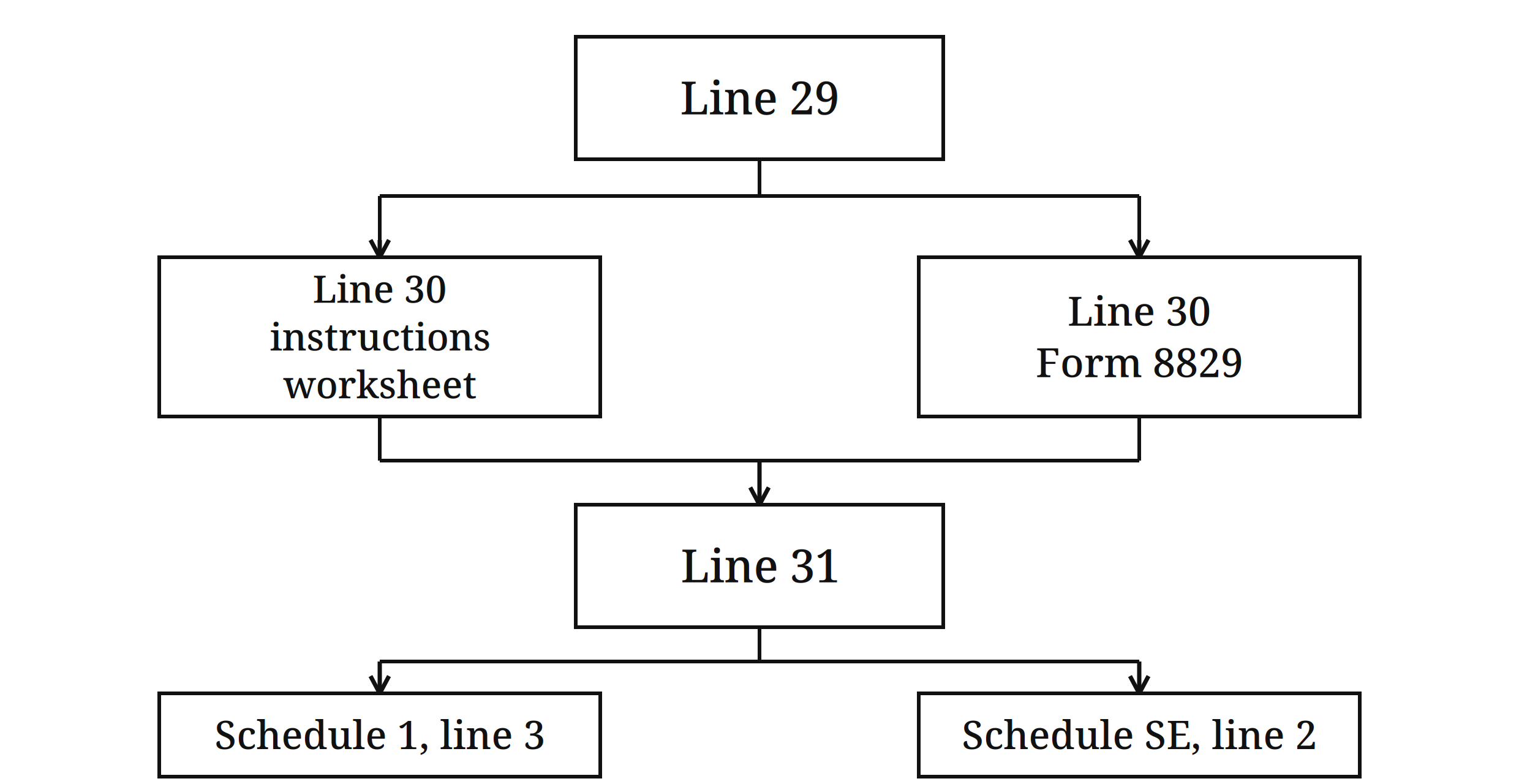
Whichever door produced it, the amount lands in the same place and does the same work.
Line 31 subtracts line 30 from line 29. Net profit falls by exactly the line 30 amount — no more, no less — and the mechanics do not change with the route that built the number.
From line 31 the figure splits toward the two places already read: Schedule 1, line 3, where business income enters the individual return, and Schedule SE, line 2, where the self-employment tax computation starts. That is why a home-office amount is never only a home-office amount on this return: it is an input to the profit figure two other schedules read.
And one boundary worth stating plainly: line 30 sits after line 28's expense total. The expenses of the business itself — the software, the supplies, the contract labor — are figured above it, on their own lines. The home enters at line 30, alone, through one of its two doors.
§7What this form does not cover
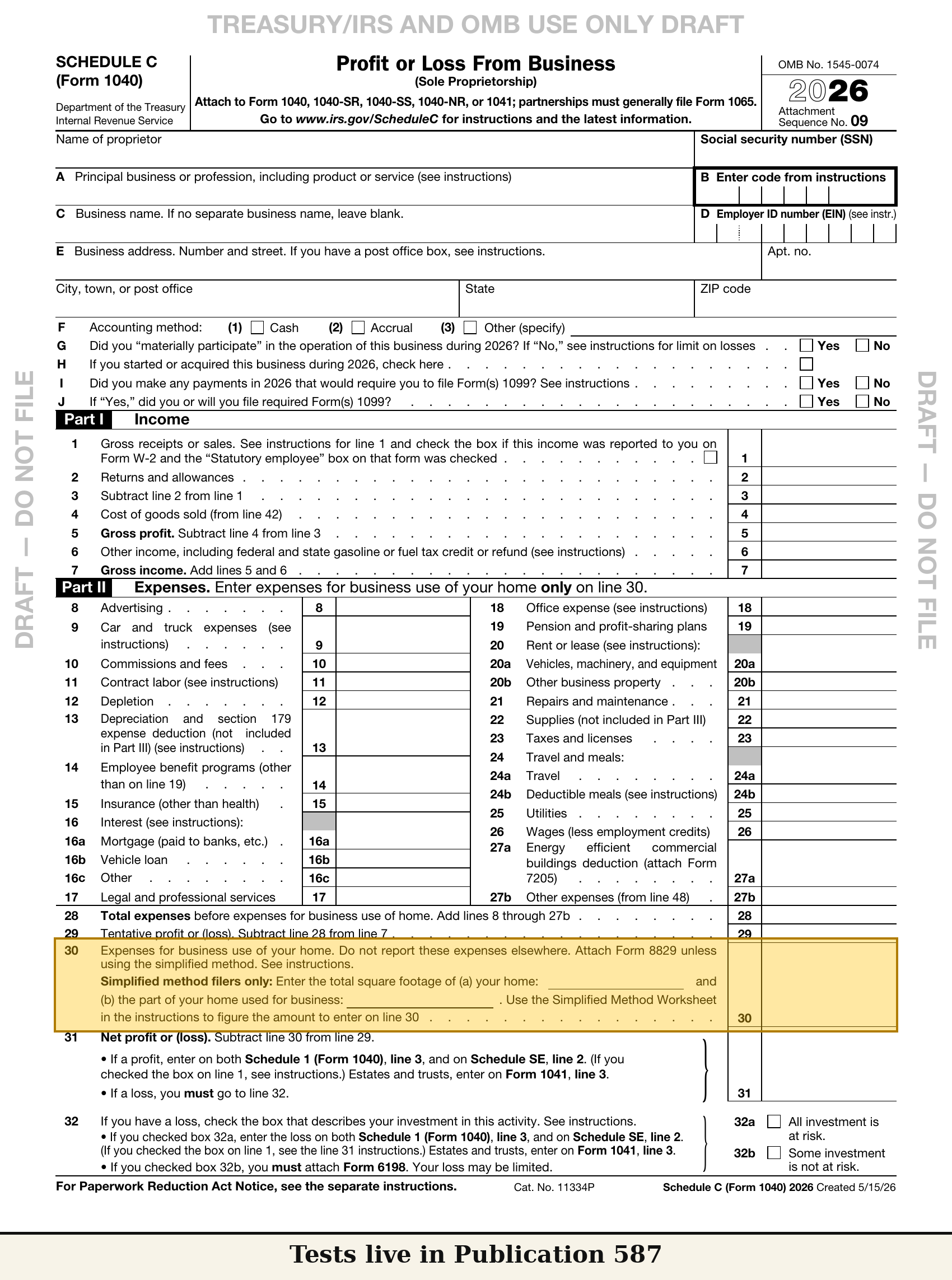
Schedule C full-page draft, greyed, with three callouts: "Tests live in Publication 587" / "Form 8829: named on line 30, not read here" / "State taxes: not covered".
What Schedule C does not settle, to close the reading.
It does not decide whether a given room passes the tests. Exclusive use, regular use, principal place — those questions live in Publication 587 and in the facts of the space, and line 30 asks none of them; it takes an amount.
It does not read Form 8829 for you: the regular method's form is named on line 30 and not opened in this article, so no line of it is stated here.
It does not choose between the doors. The simplified build and the regular build can produce different amounts for the same room in the same year, and the form prints both without ranking them.
And it does not cover state taxes — this site does not cover state taxes, in this article or any other.
§8Software numbers vs ask-a-human numbers
The split, applied to this article's two doors.
The numbers a piece of software can carry on this one: the simplified multiplication itself — square feet times five dollars, with the 300-square-foot limit and the $1,500 cap applied — and the subtraction at line 31, provided the square footage handed to it is the square footage the tests would recognize.
Numbers and questions to take to a human before you act on them: whether the space in your year actually meets the exclusive use and regular use tests as Publication 587 states them; whether a filer's work pattern meets the principal-place tests at all — a facts question, not an arithmetic one — read with the post-1999 rule beside it; and what the regular method would produce on Form 8829, since that form's lines were not read here.
That is line 30, as the draft prints it for 2026: tentative profit at line 29, the home entering at line 30 through one of two printed doors — $1,200 on 240 square feet in this article's example — and net profit coming out at line 31. IRS draft as of October 7, 2026.
Next article: the car. Line 9, Part IV, and a mileage rate that changes its price in the middle of the year. Article 10
Sources
6 claimsEvery claim above traces to a document, a tax year, a line, and the date it was checked.
-
1
Line 28 is the Part II expense total before home-office expenses; line 29 is tentative profit or loss (gross income minus line 28); line 30 is "Expenses for business use of your home" and its printed text reads: attach Form 8829 unless using the simplified method, whose worksheet is in the Schedule C instructions; line 31 = line 29 minus line 30, and line 31's text points to Schedule 1 line 3 and Schedule SE line 2
- DOC
- Schedule C (Form 1040) (2026 draft, posted 05/28/2026)
- YEAR
- 2026 draft
- LINE
- Lines 28, 29, 30, 31
- CHECKED
- 2026-10-07 — IRS draft as of 2026-10-07
-
2
Simplified method: $5 per square foot of the part of the home used for business, up to 300 square feet, maximum $1,500; the simplified-method worksheet is in the Schedule C instructions; the regular method is figured on Form 8829
- DOC
- Rev. Proc. 2013-13 / Publication 587 / IRS newsroom summaries (registry Section C3)
- YEAR
- Current as verified
- LINE
- Simplified method figures
- CHECKED
- 2026-10-06
-
3
The exclusive use and regular use tests and the principal place of business test are stated in Publication 587; Schedule C line 30 does not itself state them
- DOC
- Publication 587 (registry Section C3)
- YEAR
- Current edition at shoot to be quoted
- LINE
- Tests
- CHECKED
- 2026-10-06
-
4
Exclusive use decided room-by-room: bedroom office allowed at 8.45% of the residence; hallway/bathroom denied for occasional family/guest use (one factual line only)
- DOC
- Bulas v. Commissioner, T.C. Memo. 2011-201 (full text read)
- YEAR
- Tax year 2007; filed 2011-08-17
- LINE
- Opinion, Part II
- CHECKED
- 2026-10-08
-
5
Soliman: the Supreme Court's comparative principal-place-of-business test (relative importance of activities at each place; time spent at each place); decided 1993 under pre-1999 law; the 1997 Act's administrative/management rule (effective 1999) can change a solo filer's outcome today — test source only, never today's result
- DOC
- Commissioner v. Soliman, 506 U.S. 168 (1993); registry Section G1
- YEAR
- Case decided 1993
- LINE
- Holding / usage flag
- CHECKED
- 2026-10-06
-
6
Popov: 9th Circuit (2001) applied the same comparison the other way on extreme exclusivity facts (a living room used 4–5 hours daily for practice and for nothing else); taxpayer was a W-2 employee, 1993 tax year, pre-1999 law, 9th Circuit only — used for the shape of the analysis only
- DOC
- Popov v. Commissioner, 246 F.3d 1190 (9th Cir. 2001); registry Section G1
- YEAR
- Case decided 2001
- LINE
- Holding / usage flag
- CHECKED
- 2026-10-06
Update log
Changes are dated and kept. Old figures are never silently overwritten.