Self-Employment Tax 2026, Line by Line: Where It Is Figured — Schedule SE, Line 12
This is education, not tax advice. I'm not a CPA or EA. State taxes are not covered.
Schedule SE, Schedule C, Schedule 1, and Schedule 2 cited below are IRS draft as of 2026-10-06 — DRAFT, NOT FOR FILING. If a line changes, this page is updated in place with a dated note at the foot of the article.
- Last checked
- Tax year
- 2026
- Core line
- Schedule SE, line 12
- Changes
- Update log (1)
§1One job, one tax year, one line
The job is real estate agent. The year is 2026. The line is Schedule SE, line 12 — the self-employment tax itself, the number this whole short form exists to produce.
Article 1 covered estimated tax: the worksheet that spreads a year of tax into four payments. This article is one of the taxes inside that estimate. Schedule SE takes one number in — net profit from Schedule C — shrinks it, tests it against a printed ceiling, splits it between two rates, and sends the answer to two different schedules. We read every line it passes through.
§2Where the profit lands before this form starts
Start where Schedule SE starts: not at its line 1, but at the last line of a different form.
Schedule C figures the business's net profit at line 31 — on the 2026 draft, line 31 is still the net profit line, and its own printed text points to two destinations: Schedule 1, line 3, for income tax, and Schedule SE, line 2, for this tax.
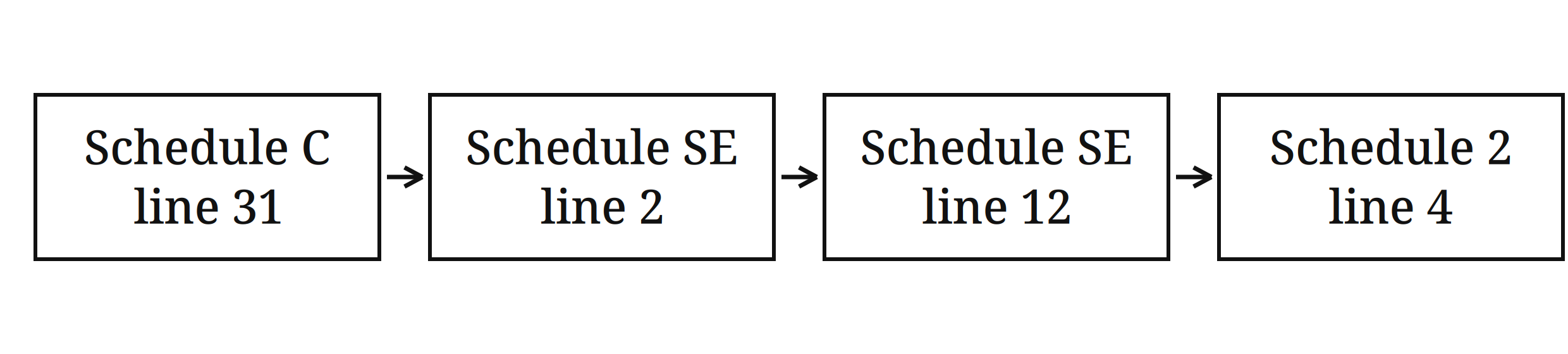
So line 2 of Schedule SE reads that net profit in. If there are also amounts from a Schedule K-1, box 14, code A, the line's text adds those — our example has none. Line 3 then combines lines 1a, 1b, and 2 into one starting figure.
Notice what has not happened yet. No percentage has been applied, and no rate has appeared. The form first re-states the profit in its own terms, and its first real operation is not a tax rate at all. It is a multiplier — and before the multiplier, there is a gate the form makes you pass: a dollar floor, printed right on the form, that can end this entire calculation in four lines.
§3The gate: line 4 and the $400 stop

Line 4a takes line 3 and multiplies it by 92.35 percent — 0.9235 — when line 3 is over zero. Whatever your net profit was, the amount this form works with from here on is 92.35 percent of it. The form does not round this to a simpler fraction, and neither will we.
Line 4b is where optional methods would enter. Our example uses none, so line 4b is zero — the optional-method lines are on the form, they are simply not read in this article.
Line 4c adds 4a and 4b. And here is the gate, in the form's own structure: if line 4c is less than $400, stop. No self-employment tax is owed on that amount, and the instructions' filing trigger is the same line read the other way — line 4c of $400 or more is when this form must be filed. One printed exception continues past the stop: church employee income, which goes to line 5. That is not any of this site's four jobs, and it is the last time it is mentioned.
That is the whole of the gate as the form prints it — a floor at line 4c and a stop. Past it, line 6 carries the shrunken figure down under a name worth reading exactly: net earnings from self-employment.
§4Worked example: $80,000 of net profit, start to finish
One worked example, with numbers used only in this article.
A real estate agent — hypothetical, not a prediction, not your numbers — finishes 2026 with net profit of $80,000 on Schedule C, line 31. No Schedule K-1 amounts. No optional methods. And in 2026, no W-2 wages at all — that last input matters in about a minute, at line 9.
Line 2 reads in the $80,000. Line 3 is $80,000.
Line 4a: $80,000 times 0.9235. That is $73,880. Line 4b is zero, so line 4c is $73,880 — well over the $400 gate, so the form continues.
Line 6, net earnings from self-employment: $73,880.
Now lines 7 through 9 set up a ceiling before any rate is applied. Line 7 is preprinted on the 2026 draft form: $184,500 — the maximum amount of combined wages and self-employment earnings subject to the Social Security part of this tax. Lines 8a through 8d collect W-2 Social Security wages and the related amounts the form lists. This example has none, so line 8d is zero. Line 9 is line 7 minus line 8d: $184,500 minus zero — $184,500 of ceiling still available.
Keep $73,880 and $184,500 side by side. Line 10 is about to compare them, and line 11 is about to ignore the comparison entirely.
| Step | Schedule SE line | Operation | Amount |
|---|---|---|---|
| Net profit, Schedule C line 31 | Input to line 2 | Hypothetical input; no K-1 amounts | $80,000 |
| Combined starting figure | Line 3 | Lines 1a + 1b + 2 | $80,000 |
| Shrunk earnings base | Line 4a | $80,000 × 92.35% (0.9235) | $73,880 |
| Optional methods | Line 4b | None in this example | $0 |
| Gate test | Line 4c | $73,880 + $0 — is it $400 or more? Yes → continue | $73,880 |
| Net earnings from self-employment | Line 6 | Line 4c + line 5b ($0) | $73,880 |
| Social Security ceiling, preprinted (2026 draft) | Line 7 | Printed on the form | $184,500 |
| W-2 Social Security wages etc. | Line 8d | None in this example | $0 |
| Remaining ceiling | Line 9 | $184,500 − $0 | $184,500 |
| Capped portion | Line 10 | Smaller of line 6 ($73,880) or line 9 ($184,500) × 12.4% | $9,161.12 |
| Uncapped portion | Line 11 | Line 6 × 2.9% — no ceiling comparison | $2,142.52 |
| Self-employment tax → Schedule 2, line 4 | Line 12 | $9,161.12 + $2,142.52 | $11,303.64 |
| Deductible half → Schedule 1, line 15 (income deduction; does not reduce line 12) | Line 13 | $11,303.64 ÷ 2 | $5,651.82 |
§5The Fork: one rate with a ceiling, one rate without
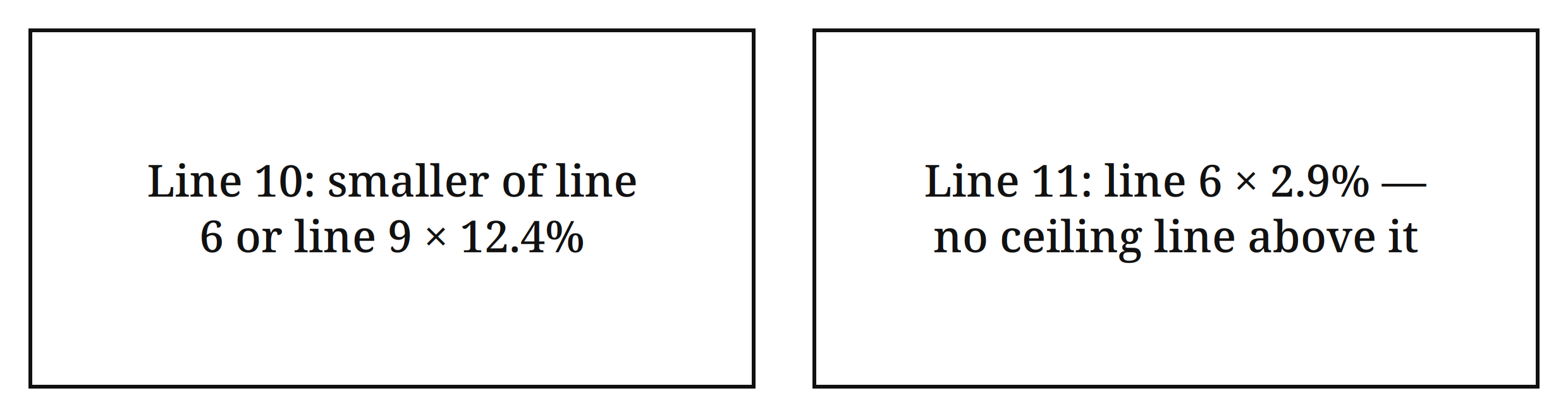
Split card — Line 10: smaller of line 6 or line 9 × 12.4%; Line 11: line 6 × 2.9% — no ceiling line above it.
Line 10 reads: take the smaller of line 6 or line 9, and multiply by 12.4 percent.
Smaller of $73,880 and $184,500 is $73,880 — the earnings figure is under the ceiling, so the ceiling changes nothing in this example. $73,880 times 12.4 percent is $9,161.12. That is line 10.
Line 11 reads differently, and the difference is the whole fork. Line 11 takes line 6 — not the smaller of anything — and multiplies by 2.9 percent. There is no line 9 in it. No ceiling is compared. $73,880 times 2.9 percent is $2,142.52. That is line 11.
Same earnings figure, two printed treatments: one percentage runs against a capped base, the other runs against the full figure. If this agent had also held a W-2 job in 2026, line 8d would not be zero, line 9 would shrink by exactly those W-2 Social Security wages, and only line 10 would feel it — line 11's base would stay line 6, unchanged. The form does not explain why it is built this way, and this site does not fill that silence in. It reads the build: capped on line 10, uncapped on line 11.
§6Line 12, and the second landing at line 13

Line 12 adds line 10 and line 11. $9,161.12 plus $2,142.52 is $11,303.64. That is the self-employment tax for this example — the core line of this article, reached.
Where does line 12 go? Its text sends it to Schedule 2, line 4 — the line that reads "Self-employment tax. Attach Schedule SE." On the 2026 draft, Schedule 2 totals its additional taxes at line 21, and that total enters Form 1040 at line 23. That is landing one: the tax itself, added into the return's tax total.
Then line 13 does something first-time filers routinely misread, so read its structure, not just its number. Line 13 is one-half of line 12: half of $11,303.64 is $5,651.82. Its text sends it to Schedule 1, line 15, in Part II — the line labeled "Deductible part of self-employment tax."
Two things line 13 is not. It is not a second tax — nothing is added at Schedule 1, line 15; Part II is the adjustments section, and Schedule 1 totals it at line 26 into Form 1040, line 10. And it is not a reduction of the tax on line 12: the $11,303.64 on Schedule 2 does not become $5,651.82. The full tax stands in one place, and half of it is deducted from income in another place. One tax, two landings — that is the build of this form.
§7What this form does not cover
What Schedule SE does not do, to close the reading.
It does not figure your profit. By the time line 2 reads a number in, Schedule C has already done that work — every expense question lives on that form. It does not decide estimated payments: the $11,303.64 in this example is a full-year figure on a return, and how a tax like this is spread across the year is Form 1040-ES and Publication 505 — Article 1's worksheet, not this form. It does not cover state taxes — this site does not cover state taxes, in this article or any other. And its optional methods — line 4b and Part II (Optional Methods To Figure Net Earnings) behind it — are printed on this form but are not read here; an example with no optional methods is the only example this article claims to walk through.
Software numbers vs ask-a-human numbers. The numbers software can carry on this form: the 92.35 percent multiplication on line 4a, the smaller-of comparison on line 10, the two rate multiplications, and the half on line 13 — provided the inputs it is handed are the inputs the form asks for. Numbers to take to a human before you act on them: what belongs in line 8 if a W-2 job and self-employment overlapped in the same year, because that input alone moves the line 10 ceiling; whether any amount in your year belongs on line 2 from a Schedule K-1; and whether an optional method is even available in your situation, since those lines were not read here.
That is Schedule SE, as the draft prints it for 2026: profit in at line 2, shrunk to 92.35 percent at line 4a, tested at the $400 gate, capped on line 10 and uncapped on line 11, taxed at line 12 — $11,303.64 on $80,000 of profit in this article's example — and half of it deducted at line 13. IRS draft as of October 6, 2026.
Next article: the form that never arrived — whether income is taxable when no 1099 shows up at all. Article 3
Sources
8 claimsEvery claim above traces to a document, a tax year, a line, and the date it was checked.
-
1
Line 2 reads net profit from Schedule C line 31 (plus Schedule K-1 box 14, code A amounts where they apply); line 3 combines lines 1a, 1b, and 2
- DOC
- Schedule SE (Form 1040) form text; cross-checked on the 2026 draft, whose line 2 cites "Schedule C, line 31"
- YEAR
- Form text 2025; 2026 draft posted 05/21/2026
- LINE
- Lines 2, 3
- CHECKED
- 2026-10-06
-
2
Line 4a: line 3 × 92.35% (0.9235) when line 3 is over $0; line 4c under $400 — stop, no SE tax (church-employee exception continues to line 5); filing trigger is line 4c of $400 or more
- DOC
- Schedule SE form text; Instructions for Schedule SE
- YEAR
- 2025, latest posted at check date; $400 wording confirmed kept on the 2026 draft
- LINE
- Lines 4a–4c; i1040sse "Who Must File"
- CHECKED
- 2026-10-06
-
3
Line 6: net earnings from self-employment = line 4c + line 5b
- DOC
- Schedule SE form text
- YEAR
- 2025; structure cross-checked on 2026 draft
- LINE
- Line 6
- CHECKED
- 2026-10-06
-
4
Line 7: maximum combined wages and self-employment earnings subject to Social Security tax, preprinted $184,500 for 2026; line 9 = line 7 − line 8d (W-2 Social Security wages and related amounts, lines 8a–8d)
- DOC
- Schedule SE (2026 draft); Publication 505 (2026) / IRS COLA table for the wage base
- YEAR
- 2026
- LINE
- Lines 7, 8a–8d, 9
- CHECKED
- 2026-10-06 — IRS draft as of 2026-10-06
-
5
Line 10: smaller of line 6 or line 9, × 12.4%; line 11: line 6 × 2.9%, no cap
- DOC
- Schedule SE form text
- YEAR
- 2025; cross-checked on 2026 draft
- LINE
- Lines 10, 11
- CHECKED
- 2026-10-06
-
6
Line 12: self-employment tax, reported on Schedule 2 (Form 1040) line 4; Schedule 2 line 21 then feeds Form 1040 line 23
- DOC
- Schedule SE (2026 draft); Schedule 2 (2026 draft, posted 06/04/2026)
- YEAR
- 2026
- LINE
- Schedule SE line 12; Schedule 2 lines 4, 21
- CHECKED
- 2026-10-06 — IRS draft as of 2026-10-06
-
7
Line 13: one-half of line 12, reported on Schedule 1 (Form 1040) line 15, Part II — "Deductible part of self-employment tax. Attach Schedule SE"; it is an income deduction and does not reduce the SE tax itself; Schedule 1 line 26 feeds Form 1040 line 10
- DOC
- Schedule SE (2026 draft); Schedule 1 (2026 draft, posted 06/08/2026)
- YEAR
- 2026
- LINE
- Schedule SE line 13; Schedule 1 lines 15, 26
- CHECKED
- 2026-10-06 — IRS draft as of 2026-10-06
-
8
Schedule C net profit stays on line 31 in the 2026 draft, and its own text points to Schedule 1 line 3 and Schedule SE line 2
- DOC
- Schedule C (2026 draft, posted 05/28/2026)
- YEAR
- 2026
- LINE
- Line 31
- CHECKED
- 2026-10-06 — IRS draft as of 2026-10-06
Update log
Changes are dated and kept. Old figures are never silently overwritten.